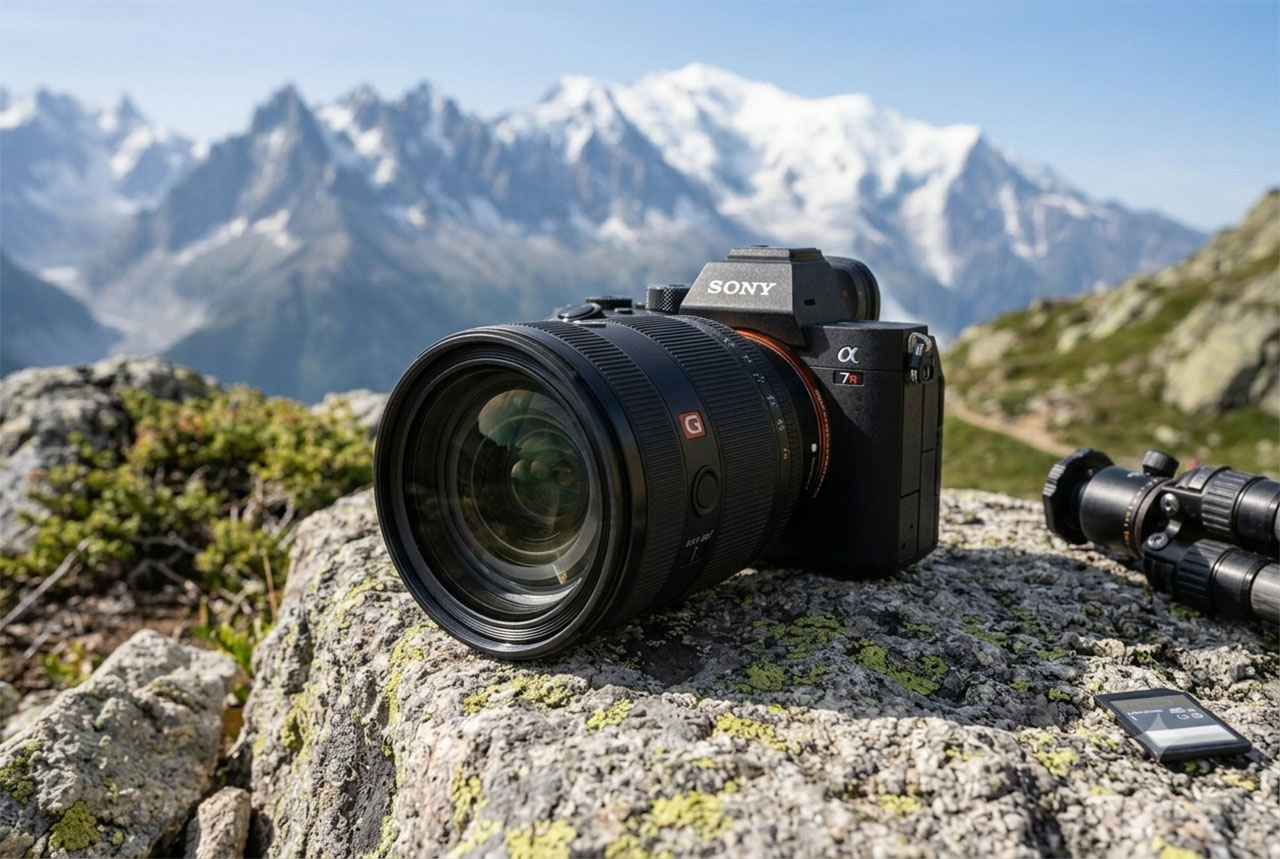
The Sony A7R VI just made history. Bill Claff of Photons to Photos has published his dynamic range measurements for Sony’s new 67MP flagship, and the numbers are the kind of thing that makes landscape photographers reconsider their medium format aspirations. Photographic Dynamic Range of 12.55 at base ISO. The highest ever measured on a full-frame camera. A dead heat, statistically, with the Fujifilm GFX100II medium format body at its own base ISO.
That is not a typo. A $4,499.99 full-frame mirrorless camera just matched a $7,500 medium format system in the single metric that most directly translates to shadow recovery headroom.
But here is what the headlines are not telling you: the sensor architecture that makes this possible, Sony’s Dual Gain Output design, has a specific set of tradeoffs baked into silicon. You get medium-format dynamic range, but you get it only under certain conditions. This is the part of the story worth understanding before you sell your GFX kit.
| Feature | Details |
|---|---|
| Sensor | 66.8MP Full-Frame Stacked CMOS (DGO) |
| Max PDR (Mech. Shutter) | 12.55 at ISO 100 |
| EDR | 14.6 (somewhat limited by bit depth) |
| DGO Active Range | ISO 100-320, mechanical shutter only |
| HCG Threshold | ISO 640 |
| Readout Speed (E-Shutter) | ~20ms |
| E-Shutter DR Penalty | ~1.15 stops (no DGO) |
| A7rV PDR (Predecessor) | 11.70 |
| GFX100II PDR | 12.55 (at base ISO) |
The headline number
An 0.85 PDR improvement over the A7rV. In plain English, that is nearly a full stop more shadow detail at base ISO. The A7rV was already no slouch, its 11.70 PDR was competitive with everything else in the full-frame market. The A7R VI does not just beat its predecessor. It beats every full-frame camera Bill Claff has ever tested on mechanical shutter.
The comparison table from SonyAddict, built directly from Photons to Photos data, tells the story:
| Camera | Max PDR | Low Light ISO | Low Light EV |
|---|---|---|---|
| Sony A7R VI | 12.55 | 6072 | 10.92 |
| Fujifilm GFX100II | 12.55 | 11665 | 11.87 |
| Sony A7V | 12.47 | 6303 | 10.98 |
| Sony A7rV | 11.70 | 5244 | 10.71 |
The A7R VI and GFX100II are effectively tied at maximum PDR. Any difference is measurement noise. For landscape and studio photographers who shoot at base ISO on a tripod with mechanical shutter, the practical implication is straightforward: you can now get medium-format-level shadow recovery in a body that mounts E-mount lenses, weighs less, and costs nearly half as much as a GFX system.
Chris Niccolls put it bluntly in PetaPixel’s review: “The Sony a7R V, amazing dynamic range. No complaints. Love that sensor, love the ability to be able to push shadows. But we are getting a dynamic range improvement over the older a7R V.”
PetaPixel’s own review testing found about the same: a little less than a full stop better than the already-strong A7rV.
How DGO actually works
To understand the tradeoff, you have to understand the technology. Conventional dual conversion gain, the kind used in the GFX100II and most modern sensors, works like a switch. At lower ISOs, the sensor runs in low conversion gain mode, which prioritizes highlight protection. At a specific ISO threshold, usually ISO 500 or so, the camera flips into high conversion gain mode. This reduces read noise and creates a visible DR bump on Claff’s charts. You have probably seen that little upward jump around ISO 500 on Photons to Photos curves and wondered what it was. That is the DCG switch.
Dual Gain Output is different. Instead of switching between low and high gain depending on ISO, the A7R VI reads every pixel twice during a single mechanical shutter exposure. Once at low amplification, to preserve highlights from clipping to pure white. Once at high amplification, to pull ultra-clean detail out of deep shadows. The BIONZ XR processor merges both readouts into a single RAW file.
Because both reads happen within the duration of the mechanical shutter actuation, there is no ghosting and no motion artifact. This is not multi-shot HDR bracketing. It is a single capture with two parallel gain paths.
Sony’s implementation is not the first. Panasonic’s S1II uses a Sony-made partially stacked DGO sensor, and the Sony A7V introduced the architecture to the Alpha lineup with a 33MP partially stacked design. The A7R VI is the first fully stacked, high-resolution DGO sensor, and the numbers show Sony has refined the design.
The results speak for themselves at ISO 100 to 320. At ISO 400 and above, the DGO advantage disappears. The camera reverts to conventional behavior, and by ISO 500, the GFX100II’s larger sensor area and old-school DCG approach pull ahead and stay ahead for the rest of the ISO range.
The tradeoff nobody is talking about
Every stacked sensor design involves a choice. You can use the stacked DRAM layer to maximize readout speed, the path Sony took with the A1II and its blistering 3.8ms readout. Or you can use it to process the dual-gain readout that DGO requires. You cannot have both in the same sensor at the same time.
Sony chose dynamic range over speed for the A7R VI. The electronic shutter readout speed is roughly 20ms. To put that in context, the A1II reads its sensor more than five times faster. The consequence is more rolling shutter distortion with fast-moving subjects in electronic shutter mode.
But there is a bigger consequence, and it is the one most buyers will not discover until they read the manual. DGO only works on the mechanical shutter. Switch to electronic shutter for silent shooting or 30fps bursts, and the camera cannot perform the dual readout. It falls back to standard dual conversion gain behavior. PetaPixel measured the e-shutter dynamic range at 11.4 PDR at base ISO, a loss of just over one stop. That is less severe than the A7V, where FujiRumors documented a loss of up to 1.5 stops on its DGO sensor. Still, the electronic shutter files are noisier in the shadows, and the dynamic range advantage over the A7rV mostly evaporates.
DPReview’s studio tests confirmed this pattern: slightly noisier shadows in e-shutter mode compared to mechanical. CineD’s lab test, focused on video, found the rolling shutter numbers unremarkable for a stacked sensor and the exposure latitude competitive but not revolutionary in 10-bit video modes.
This is the tradeoff. If you shoot landscapes on a tripod, architectural interiors, or controlled studio work, you will rarely leave mechanical shutter. The DGO advantage is yours, full strength. If you shoot wildlife, sports, or anything that demands silent shooting or high burst rates, the A7R VI is not giving you the class-leading DR the headlines promise. The A1II remains the better tool for that job, with its 3.8ms readout and no DGO-related e-shutter penalty.
Full-frame vs medium format: the real story
The PDR numbers at base ISO are a tie. That is a genuine engineering achievement and worth acknowledging. But let us not get carried away.
PDR is one metric. It measures shadow recovery headroom under a specific noise threshold. It does not measure tonal smoothness, color depth at the extremes of the exposure range, or the subjective quality of highlight roll-off. Medium format sensors, with their physically larger photosite area, tend to produce smoother tonal transitions even at identical PDR numbers. The GFX100II also shoots 16-bit RAW, compared to the A7R VI’s 14-bit pipeline. Whether that matters for your work is a separate question, but it is a real difference.
And above ISO 500, the conversation changes entirely. The GFX100II’s DCG switch restores a clear advantage that it holds for the rest of the ISO range. At ISO 1600, the gap is meaningful. At ISO 6400, it is significant. The A7R VI wins the base ISO battle, but medium format still owns the higher ISOs for dynamic range. The GFX100II also has a Low Light ISO score of 11665 versus the A7R VI’s 6072, so its high ISO noise performance is genuinely superior even before factoring in the sensor size.
For the landscape shooter working at base ISO on a tripod, the A7R VI is now a legitimate alternative to medium format at a dramatically lower system cost. For the photographer who regularly works at ISO 800 and above, medium format still pulls soundly ahead.
What this means for the sensor landscape
Sony is all-in on DGO. The architecture now spans the A7V at 33MP, the A7R VI at 67MP, and the Panasonic S1II at 24MP using a Sony-supplied DGO sensor. That is three bodies from two manufacturers across a wide resolution range, all using the same fundamental dual-read approach. This is not a one-off experiment. It is a sensor platform.
Canon has no publicly known DGO sensor in any stills camera. Nikon has shown no DGO development. Fujifilm, according to FujiRumors, is actively evaluating DGO for future APS-C X-series and GFX bodies, though their own user survey found only about 40 percent of respondents strongly preferred DGO over conventional DCG. The remaining 60 percent either preferred DCG or had no strong preference, which suggests the technology is not yet a no-brainer for every use case.
The most interesting question is what the next generation of medium format sensors does in response. If Sony can extract GFX100II-level PDR from a full-frame stacked sensor, the pressure is on Fujifilm and Hasselblad to widen the gap again. A 100MP medium format sensor with DGO would be an entirely new class of dynamic range performance. Or Fujifilm could go the other direction, pursuing higher resolution or faster readout instead of chasing DR numbers that full-frame has now matched at base ISO.
Who should buy this camera
If you are a landscape photographer, an architectural shooter, or a studio photographer who works at base ISO with mechanical shutter, the A7R VI is the most compelling high-resolution full-frame camera ever made for dynamic range. The improvement over the A7rV is real and significant. The GFX100II comparison is not marketing spin, it is data.
If you shoot wildlife, sports, or any subject where you rely on electronic shutter for silent shooting or high burst rates, pause. The A7R VI’s DGO advantage does not transfer to electronic shutter mode. The A1II’s faster readout and consistent DR across shutter types makes it the better action camera, even if its maximum PDR is lower on paper.
The A7rV owner who prints large and routinely pushes shadows three or four stops in post will see a genuine upgrade. The A7rV owner who mostly shoots at moderate ISOs and does not aggressively recover shadows may not notice a practical difference large enough to justify the switch.
As always, Bill Claff’s data tells you what the sensor can do under controlled conditions. Whether that translates to a visible difference in your work depends on what you shoot, how you expose, and how hard you push your files in post. But the numbers are not ambiguous. This is the best dynamic range ever measured on a full-frame camera. The tradeoffs are real, but for the right photographer, so is the leap forward.