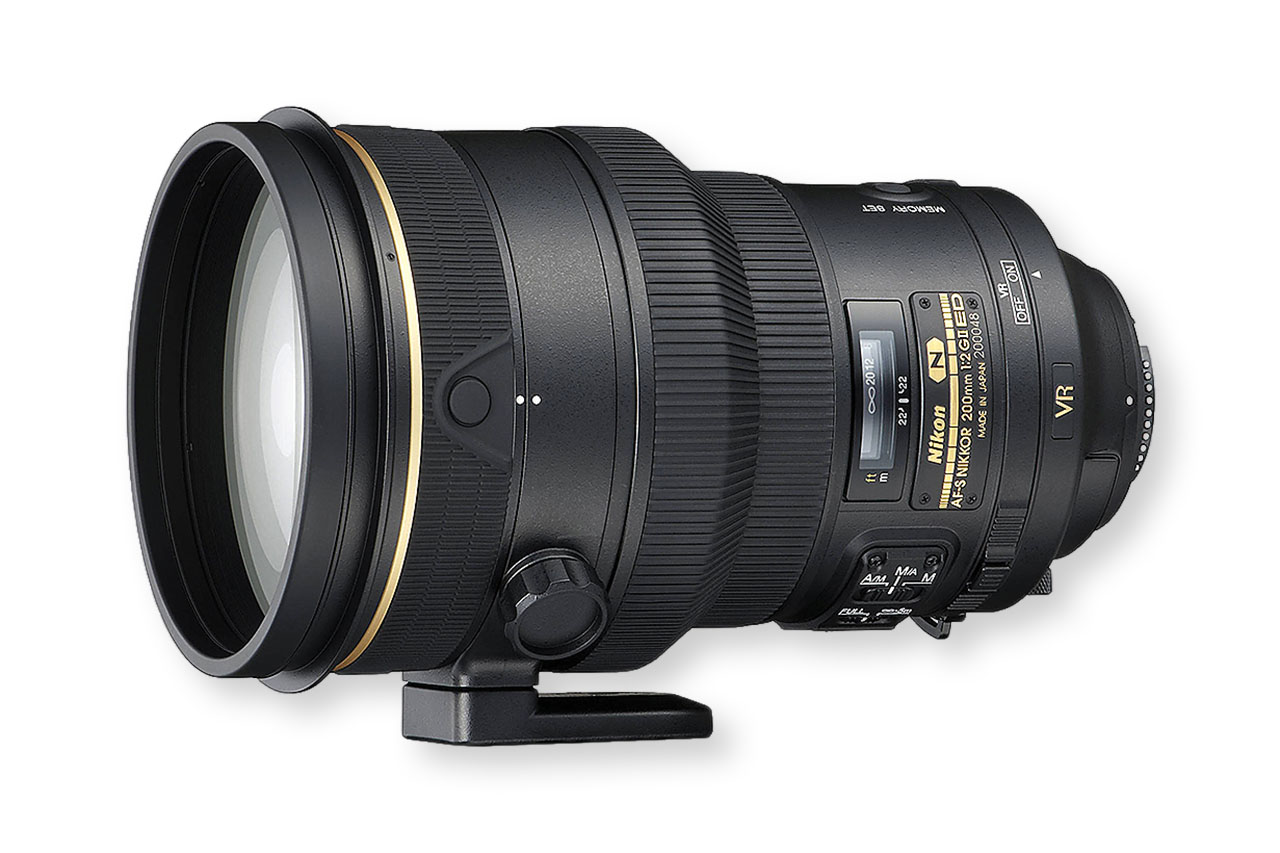
In the Atacama Desert of Chile, at an altitude of 1,570 meters, a remote observatory called Chilescope runs a telescope designated Telescope 4. Its official name is the Very Small Telescope. The optical core is not a Takahashi, not a PlaneWave, not a custom astrograph. It is a Nikon AF-S 200mm F/2G camera lens, shooting wide open, feeding a FLI Proline 16200 monochrome CCD with 6-micron pixels. Telescope Live operates an identical setup at their CHI-5 station in the Rio Hurtado valley.
If a professional remote observatory trusts Nikon F-mount glass to deliver data paying clients rely on, the optical family tree those lenses belong to is worth taking seriously. The ED telephotos Nikon built from the late 1970s through the mid-2000s share that same engineering lineage. Most of the budget-friendly examples on the used market are manual-focus designs, but even the ones with autofocus capability are priced as if AF is the only thing that matters. It is not. Astrophotography is manual focus by definition, and decades-old ED glass that cost thousands to manufacture now sells for hundreds.
This is the first in a series covering undervalued vintage lenses for astrophotography across different mounts. We start with Nikon F, the deepest and most accessible ecosystem of ED telephotos on the used market.
Why F-mount, and why now
The migration to Z-mount has been the best thing to happen to Nikon F used prices. Every photographer trading a D850 for a Z8 pushes another set of F-mount glass onto the secondhand market. The lenses hit hardest are the vintage designs. Many of them lack modern autofocus motors, some rely on screw-drive AF, and a few have early AF-S systems. None of it is fashionable for sports, wildlife, or portraits. For astrophotography, none of it matters.
Autofocus is irrelevant when you are shooting 3-minute guided exposures of the Horsehead Nebula. You focus once on a bright star using 10x live view magnification, lock the ring down, and leave it alone. What you need is a lens that stays focused, does not creep under its own weight, and delivers sharp stars corner to corner at working aperture. These old telephotos, built from brass and aluminum with hand-ground ED elements, were engineered exactly for that.
Nikon’s ED (Extra-low Dispersion) glass arrived in the 1970s and changed what telephoto lenses could do. Before ED glass, chromatic aberration at long focal lengths was a hard physical limit. Purple halos around high-contrast edges were accepted as the cost of doing business. ED elements suppress that dispersion. For astrophotography, this is the entire game: bright stars against a black background are the most demanding test of chromatic correction a lens will ever face.
Adapting F-mount glass to a modern mirrorless body costs $200 for a used FTZ II adapter, adds no optical elements, and preserves infinity focus. On a Z6 III or Z8 sensor with modern dynamic range and low read noise, a lens from the 1980s can produce images that rival dedicated astrographs costing several times as much.
The rules of the game
Before getting into specific lenses, a handful of principles apply across the board. These come primarily from Rudy E. Kokich’s definitive 2015 CloudyNights article, where he tested more than two dozen telephoto lenses for astrophotography and distilled his findings into a set of practical rules.
Rule 1: Zoom lenses are not suitable. Every zoom lens makes optical compromises to function across a range of focal lengths. For pinpoint stars, those compromises show up as coma, astigmatism, and chromatic aberration that no amount of stopping down can fully fix.
Rule 2: All telephoto lenses need to be stopped down at least one stop. Even ED glass has residual chromatic aberration wide open. Kokich recommends reducing aperture by one to three stops depending on the lens. A lens rated F4 wide open should be treated as an F5.6 or F8 for astro use. The AF-S 200mm F/2G at Chilescope is an exception, a rare lens corrected well enough to use wide open, which is why it costs what it costs.
Rule 3: Use front step-down rings, not the internal iris. Stopping down with the lens’s built-in aperture blades creates diffraction spikes, eight of them, around every bright star. Some people like the look. Kokich did not. The solution is to leave the internal iris wide open and screw a series of step-down rings into the front filter thread. These act as a circular aperture stop. Star images stay round. eBay sells step-down ring sets for a few dollars.
Rule 4: A good UV filter improves contrast. Kokich recommends the Tiffen Haze 2 (not multicoated, but the best contrast enhancement) or the Hoya Pro One Digital MC UV(0) as a more practical alternative.
Rule 5: Full-spectrum modified cameras require narrowband filters. If your camera has had its internal UV/IR cut filter removed, the extended red and infrared sensitivity overwhelms any telephoto lens’s chromatic correction. Quality apochromats can be tamed with broadband UV/IR cut filters. Telephoto lenses cannot. You will need narrowband H-alpha or OIII filters instead.
Rule 6: Support the lens at two points. Long lenses sag. A lens mounted only at the camera body will shift during long exposures as gravity works on the front-heavy assembly. Use an adjustable retaining ring near the front of the lens barrel with nylon-tipped screws to create a second support point, tight enough to prevent movement but not so tight it interferes with focusing.
Rule 7: Focus just slightly inside infinity. Because residual chromatic aberration favors red wavelengths slightly behind the focal plane of blue wavelengths, the sharpest star image is not at the point where the star is smallest. Back off a hair, letting the star image just barely begin to enlarge. This biases focus toward the less objectionable red end of the spectrum.
The lenses
Nikkor 180mm F/2.8 ED AI-S: The gateway lens
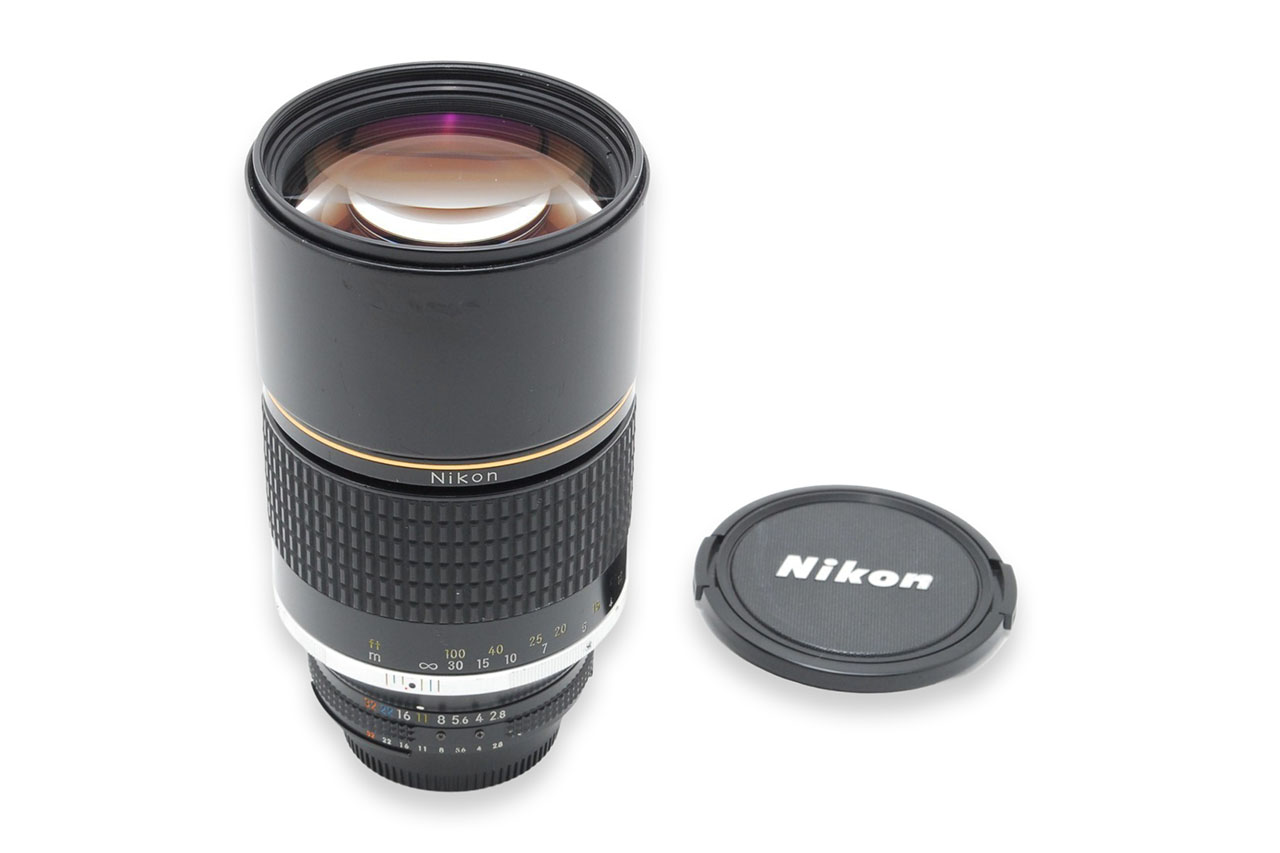
If you want to test whether vintage Nikon glass has a place in your astro workflow for less than the cost of a decent dinner, start here. The 180mm F/2.8 ED uses a simple 5-element, 5-group design with a single large ED element. There is not much to go wrong, sample variation is minimal, and used copies run $150 to $300.
The AstroBin community has validated this lens thoroughly. Three separate equipment pages exist for different versions of the 180mm F/2.8, and users have posted direct comparison threads against the 300mm F4 ED and the 300mm F4.5. One AstroBin user noted that “in terms of correction the 300mm F4 AFS is a better bet than the old design of the 180mm,” which is fair. The 180mm shows some coma on bright stars when shot wide open at F2.8. Stopped down to F4 with a front step-down ring, star shapes are clean enough for serious work.
At 180mm on full-frame, the field of view frames the Orion Nebula (M42) with surrounding dust, the Andromeda Galaxy (M31) with room for its satellite galaxies, and the North America Nebula (NGC 7000) in a single frame. On a Sky-Watcher Star Adventurer, you can manage 60 to 90-second unguided exposures. With guiding, 3 to 5 minutes is realistic.
| Feature | Details |
|---|---|
| Focal Length | 180mm |
| Aperture | F2.8-F22 |
| Optical Design | 5 elements in 5 groups, 1 ED |
| Aperture Blades | 9 |
| Min Focus | 1.8m |
| Filter Thread | 72mm |
| Weight | 800g |
| Used Price | $150-$300 |
| eBay Link | Buy on eBay |
Nikkor AF-S 300mm F/4D ED IF: The sweet spot
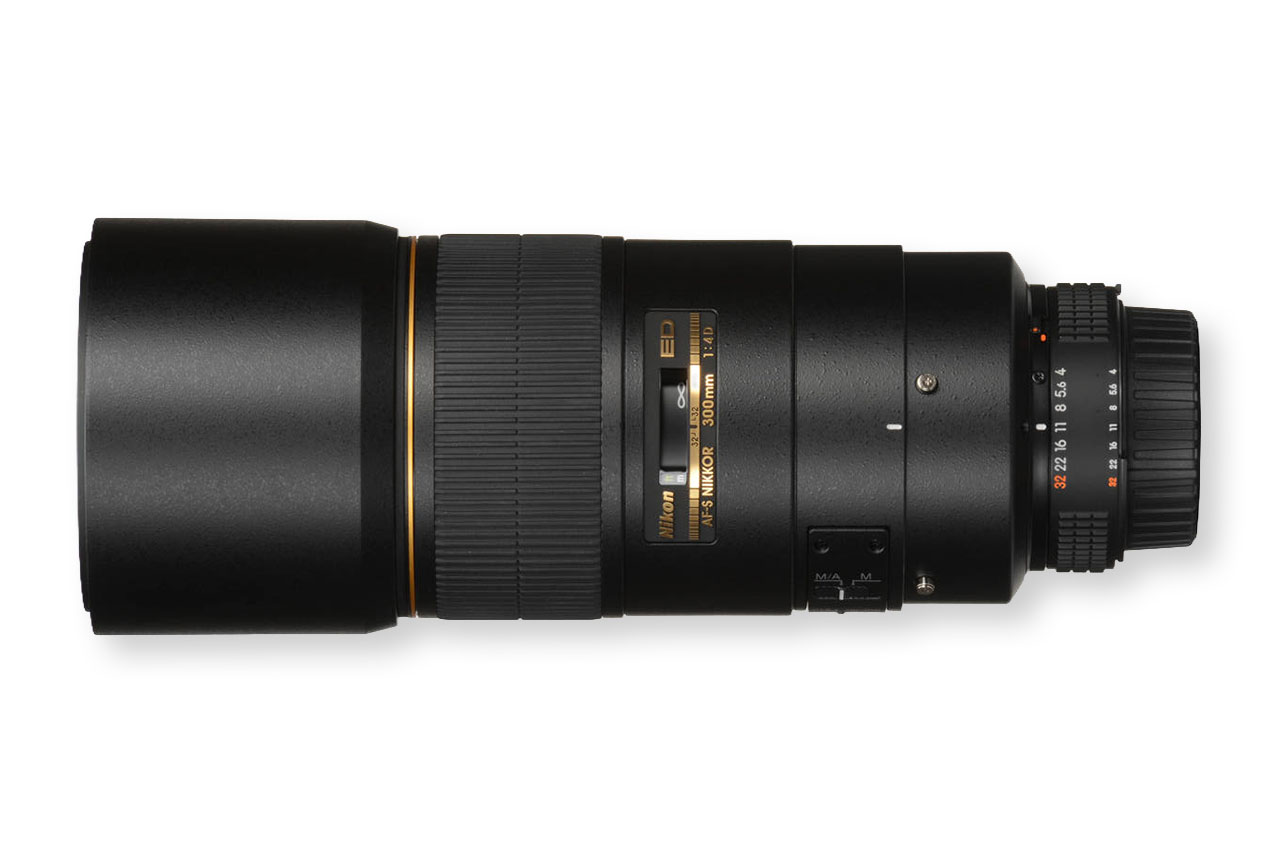
This is the 300mm that the astrophotography community actually recommends. Over on Reddit’s r/AskAstrophotography, when someone asked about the older AF Nikkor 300mm F4 ED IF for deep sky work, the response was unambiguous: the AF-S version is the one to get, with one commenter noting that the “AF-S” designation is critical. On CloudyNights, a dedicated thread titled “Nikon Nikkor ED 300mm F4 or scope?” compared the AF-S version directly against an AstroTech AT60ED refractor with a 0.8x reducer. The lens held its own.
There are two 300mm F4s in Nikon’s F-mount catalog, and it is easy to grab the wrong one. The original AF Nikkor 300mm F4 ED IF (1987 to 2000) uses a simpler 8-element, 6-group design driven by a screw-drive AF motor in the camera body. It is a solid lens, but it was built for film. The AF-S Nikkor 300mm F/4D ED IF that replaced it in 2000 is a complete optical redesign: 10 elements in 8 groups, still with two ED glass elements, plus Nikon’s Silent Wave Motor for quiet internal focusing. Nikon recalculated the glass for higher resolution, and it shows at the pixel level on modern sensors.
The optical redesign matters for astrophotography. The AF-S version delivers sharper corners and better control of chromatic aberration on bright stars, the exact things that make or break a deep-sky image. It also focuses closer (1.45m versus 2.5m on the older version) and uses a more common 77mm front filter thread, which makes sourcing step-down rings easier and cheaper.
At F4 wide open, center sharpness is exceptional and corner performance is very good, a noticeable step up from the older AF version. Stopping down to F5.6 with a front step-down ring renders stars as clean pinpoints across a full-frame sensor. The Internal Focusing design keeps the lens barrel from extending during focus, so the balance point on a star tracker stays constant.
At 300mm, the target list expands dramatically. Andromeda fills the frame with detail. M42 resolves the Trapezium cluster. The Pleiades shows reflection nebulosity. The Rosette Nebula, the Lagoon, the Trifid, these are all within reach on a tracker with 2 to 3-minute exposures. For someone using a Sky-Watcher Star Adventurer or iOptron SkyGuider Pro, 300mm is about the practical limit without autoguiding.
The used price reflects the fact that this is the lens people actually want. Expect to pay $400 to $650, roughly double what the older AF version commands. It is worth every dollar.
| Feature | Details |
|---|---|
| Focal Length | 300mm |
| Aperture | F4-F32 |
| Optical Design | 10 elements in 8 groups, 2 ED |
| Aperture Blades | 9 |
| Min Focus | 1.45m |
| Filter Thread | 77mm |
| Weight | 1,440g |
| Used Price | $400-$650 |
| eBay Link | Buy on eBay |
A budget alternative exists in the 300mm F/4.5 ED, a simpler non-IF manual-focus design that CloudyNights users have spotted selling for as low as $100. It has an AstroBin equipment page but fewer verified astro images. At that price, if you find a clean copy, the risk is minimal.
Nikkor 400mm F/3.5 ED IF AI-S: The threshold lens
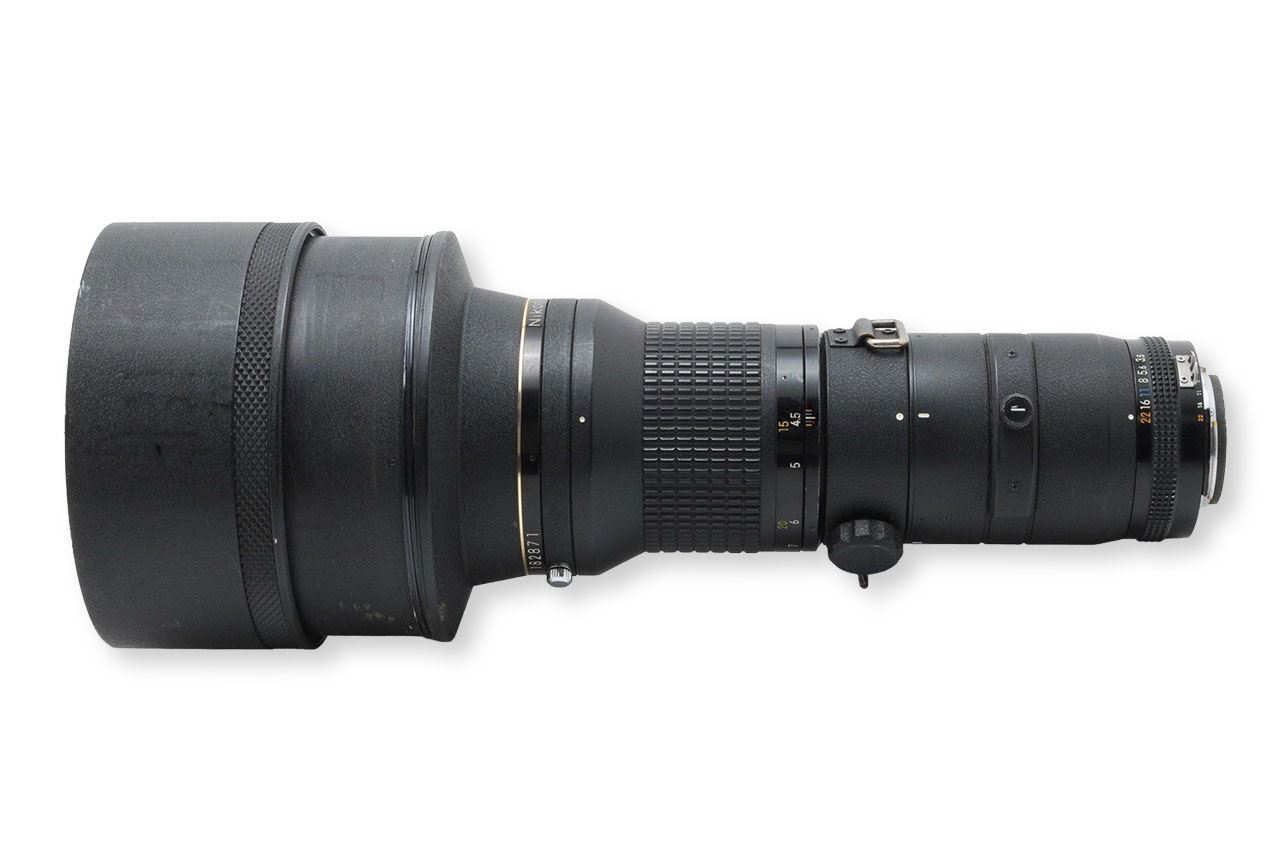
At 400mm, you cross a line. You are no longer in “camera lens on a tracker” territory. You are in “small telescope on an equatorial mount” territory. The 400mm F/3.5 ED IF AI-S was Nikon’s flagship super-telephoto in the early 1980s, built for Olympic sports photographers and National Geographic wildlife assignments. It cost around $5,000 new. Today it sells for $450 to $800.
Let us be direct about what this lens is and is not. Rudy Kokich, who tested over two dozen lenses for astrophotography on CloudyNights, described the 400mm F/3.5 with a single word: “decent.” Not excellent, not outstanding. Decent. For a lens that was once Nikon’s best, that is a measured endorsement. A CloudyNights user who tested it in daytime posted “sharpness and vivid colors, CA well contained even at full aperture.” Daytime performance and nighttime star fields are different animals. The lens has two ED elements, which should control chromatic aberration well, but at 400mm and F3.5, any residual CA becomes magnified against a black sky.
What the 400mm F/3.5 offers that a $500 telescope often cannot is a flat, corrected field without needing a separate field flattener, a robust mechanical assembly that holds collimation, and a full stop more speed than most budget 400mm refractors. A typical 72mm doublet refractor at 400mm runs around F5.6 to F6. The Nikon at F3.5 gathers 2.5 times more light per unit time. That means shorter exposures or lower ISO, both of which reduce noise.
The trade-off is that a dedicated astrograph at this price point will have better chromatic correction and sharper corners. If your goal is the tightest possible stars across a full-frame sensor, save for a proper triplet refractor. If you want to explore the 400mm focal length for galaxies and smaller nebulae without spending $2,000 on a telescope, the Nikon is the cheapest ticket in.
Mount requirements are serious. A Sky-Watcher Star Adventurer is not enough. You need at minimum an HEQ5, CEM26, or equivalent German equatorial mount rated for at least 10kg of payload. Autoguiding is strongly recommended.
| Feature | Details |
|---|---|
| Focal Length | 400mm |
| Aperture | F3.5-F22 |
| Optical Design | 8 elements in 6 groups, 2 ED |
| Aperture Blades | 9 |
| Min Focus | 4.5m |
| Filter Thread | 122mm (39mm drop-in) |
| Weight | 2,100g |
| Used Price | $450-$800 |
| eBay Link | Buy on eBay |
Nikkor AF-S 200mm F/2G ED VR II: What the observatories use
Not a budget recommendation. But worth understanding.
Chilescope’s Telescope 4 uses an AF-S Nikkor 200mm F/2G ED VR II with a 13-element, 9-group optical formula containing three ED glass elements and one Super ED element, plus Nikon’s Nano Crystal Coat. They shoot it wide open at F2. The lens feeds an FLI Proline 16200 CCD with 6-micron pixels on a German equatorial mount tracking at under 1 arcsecond RMS. This is a lens that, in the hands of a professional observatory under Chilean skies, produces publishable deep-sky data.
The VR II version, released in 2010, is the second generation of this lens. The original 200mm F/2G VR from 2004 shared the same optical formula but lacked Nano Crystal Coat and used an earlier VR system. Chilescope’s specification of Nano Crystal Coat pins their unit as the VR II.
The point is not that you should buy one. Used prices run $2,000 to $5,000. The point is that when Chilescope needed an astrograph in the 200mm range, they did not design a custom telescope. They bought a Nikon lens. The optical engineering in Nikon’s ED telephoto family, from the $150 180mm F/2.8 ED AI-S to the $5,000 AF-S 200mm F/2G ED VR II, shares a common heritage. The budget end of that family is where the value lives.
| Feature | Details |
|---|---|
| Focal Length | 200mm |
| Aperture | F2-F22 |
| Optical Design | 13 elements in 9 groups |
| Special Glass | 3 ED + 1 Super ED |
| Coating | Nano Crystal Coat |
| Aperture Blades | 9 (rounded) |
| Min Focus | 1.9m |
| Filter Thread | 52mm drop-in |
| VR | VR II (4 stops) |
| Weight | 2,930g |
| Used Price | $2,000-$5,000 |
| eBay Link | Buy on eBay |
What to look for when buying used
These lenses range from roughly 25 to 45 years old. Condition matters.
Fungus and internal haze are dealbreakers. Astrophotography pushes every photon through the lens for minutes at a time. Haze scatters light and produces halos around bright stars. Fungus etches coatings permanently. Bring a flashlight and inspect every element. If the seller will not provide internal glass photos, walk away.
Focus ring smoothness. The helicoid grease hardens over decades. A stiff ring can be re-lubricated by a repair shop for $100 to $200. Budget for it unless the seller confirms recent service.
Aperture blades. Stop down to F22 and release. The blades should snap open instantly. Oil on the blades, common on older lenses, produces uneven exposures.
Tripod collar. Many of these lenses shipped with dedicated rotating tripod collars. Make sure it is included. Replacements are rare, expensive, and essential for balanced mounting on a tracker.
Caps and hood. The built-in sliding hood on the 400mm is part of the lens. If missing, the front element is exposed and replacement hoods are nearly impossible to find.
Three budget tiers
Under $600 total, ready to shoot: Nikon 180mm F/2.8 ED AI-S ($200) + FTZ II adapter ($200 used) + Sky-Watcher Star Adventurer 2i ($300 used). This setup captures Orion, Andromeda, Pleiades, the North America Nebula, and the larger emission nebulae. Add $10 for a set of step-down rings.
Under $1,000 for the optical chain: Nikon AF-S 300mm F/4D ($500) + FTZ II ($200) + front step-down rings + an autoguiding package if your tracker supports it. This is the setup that produces images you will want to print. Dozens of deep-sky targets become viable. Add a clip-in H-alpha filter for emission nebulae from light-polluted skies.
Under $2,000, deep-sky serious: Nikon 400mm F/3.5 ED IF AI-S ($650) + used HEQ5 or CEM26 mount ($600 to 800) + guide scope and camera ($200). At this level you are imaging galaxies and nebulae at resolutions approaching what small observatories produced 20 years ago. The mount matters more than the lens at this point. Spend accordingly.
The window on these lenses is closing. The AF-S 300mm F/4D that sold for $400 three years ago now commands $550. The 400mm F/3.5 has doubled in five years. Word is getting out. These are still bargains at current prices, and they will not be for much longer.
Next in this series: Minolta and Sony A-mount lenses for astrophotography on a budget.