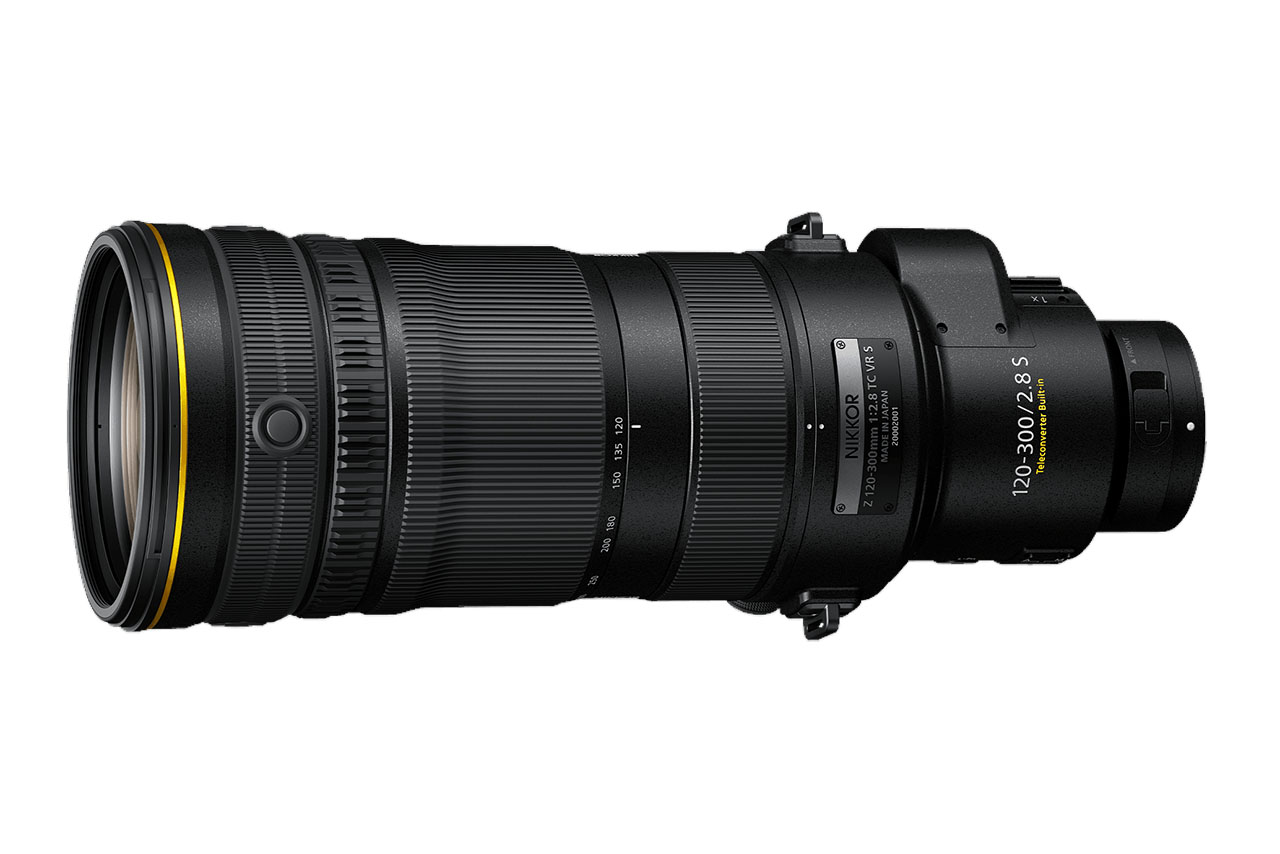
Nikon Developing NIKKOR Z 120-300mm F2.8 TC VR S With Built-In Teleconverter
Nikon has officially announced the development of the NIKKOR Z 120-300mm F2.8 TC VR S, a telephoto zoom lens that fills one of the most important gaps in the Z-mount lineup. The lens features a built-in 1.4x teleconverter, extending the focal range to 120-420mm while maintaining the fast F2.8 aperture at the wide end.
This is a development announcement, not a full product launch. Nikon has not released pricing, availability, or complete specifications. But the announcement itself is significant. The 120-300mm F2.8 category is a staple of professional sports photography, and until now, Z-mount users have had to adapt the F-mount AF-S 120-300mm F2.8E FL ED VR via Nikon’s FTZ adapter.
Why this lens matters
The 120-300mm F2.8 is one of the most versatile lenses in professional sports photography. At 120mm, it is wide enough for environmental shots, sideline action, and team celebrations. At 300mm, it brings you close enough for individual player shots, track events, and mid-field action. The constant F2.8 aperture means you can shoot in stadium lighting without pushing ISO to extremes.
The built-in teleconverter is what makes this lens particularly interesting. Flip a switch and the 300mm becomes 420mm at F4. That is the difference between a tight shot of a quarterback and a tight shot of the receiver he is throwing to. For wildlife photographers, 420mm at F4 is genuinely useful for larger animals and birds in open environments.
What does that mean in practice? A sports photographer covering football or soccer can work an entire game with a single lens. No lens changes in the rain, no missing the decisive moment because you were swapping bodies. The teleconverter is always there, always ready, with no extra glass to carry or attach.
Built-in teleconverter: the practical advantage
External teleconverters are common, but they are also a hassle. You have to carry them, attach them in the field, and accept the light loss and potential autofocus slowdown. A built-in teleconverter eliminates all of that. Nikon has used this approach before on the F-mount AF-S 180-400mm F4E TC1.4 FL ED VR, which was widely praised for its convenience.
The 1.4x converter turns the 120-300mm F2.8 into a 168-420mm F4. The effective aperture drops by one stop, which is the physics of teleconverters. At F4, you are still shooting a lens that is faster than most zooms at the long end. For comparison, Nikon’s own Z 100-400mm F4.5-5.6 is slower at every focal length, and the Z 400mm F2.8 TC is a prime with less flexibility.
Where it sits in the Z-mount lineup
Nikon has been aggressive about building out its Z-mount telephoto lineup. The company already offers the NIKKOR Z 400mm F2.8 TC VR S, the 600mm F4 TC VR S, and the 800mm F6.3 VR S for wildlife and extreme sports. The 100-400mm F4.5-5.6 covers the enthusiast market. The 120-300mm F2.8 TC fills the gap between the flexible but slow 100-400mm and the fast but fixed 400mm F2.8.
For professional sports shooters, this is the lens that justifies staying in or moving to the Z system. The adapted F-mount 120-300mm works well, but native Z-mount optics offer better autofocus performance, in-lens correction profiles, and the general responsiveness that comes from direct electronic communication between lens and body.
What we still do not know
Nikon has not disclosed the optical formula, weight, dimensions, or price. The F-mount AF-S 120-300mm F2.8E weighed 3,250g and cost around $9,500 at launch. The Z-mount version will likely be lighter thanks to improved optical design and materials, but it will still be a substantial lens. Expect a price in the $8,000 to $10,000 range.
The lens will carry the S-Line designation, Nikon’s mark for premium optics. It will also feature VR (Vibration Reduction) for handheld shooting, which is essential for a lens of this size and focal length.
Key Specifications
| Feature | Details |
|---|---|
| Lens Mount | Nikon Z mount |
| Format | Full Frame |
| Focal Length | 120-300mm (168-420mm with built-in 1.4x TC) |
| Aperture | F2.8 constant (F4 with TC engaged) |
| Teleconverter | Built-in 1.4x |
| Image Stabilization | VR (Vibration Reduction) |
| Series | S-Line |
Looking ahead
Nikon has not provided a release date, but development announcements from the company typically lead to full launches within 6 to 12 months. Given the timing, a late 2026 or early 2027 release seems plausible.
For sports and wildlife photographers invested in the Z system, this lens has been at the top of the wish list since the first Z cameras arrived. The wait is not over yet, but Nikon has finally confirmed it is coming.