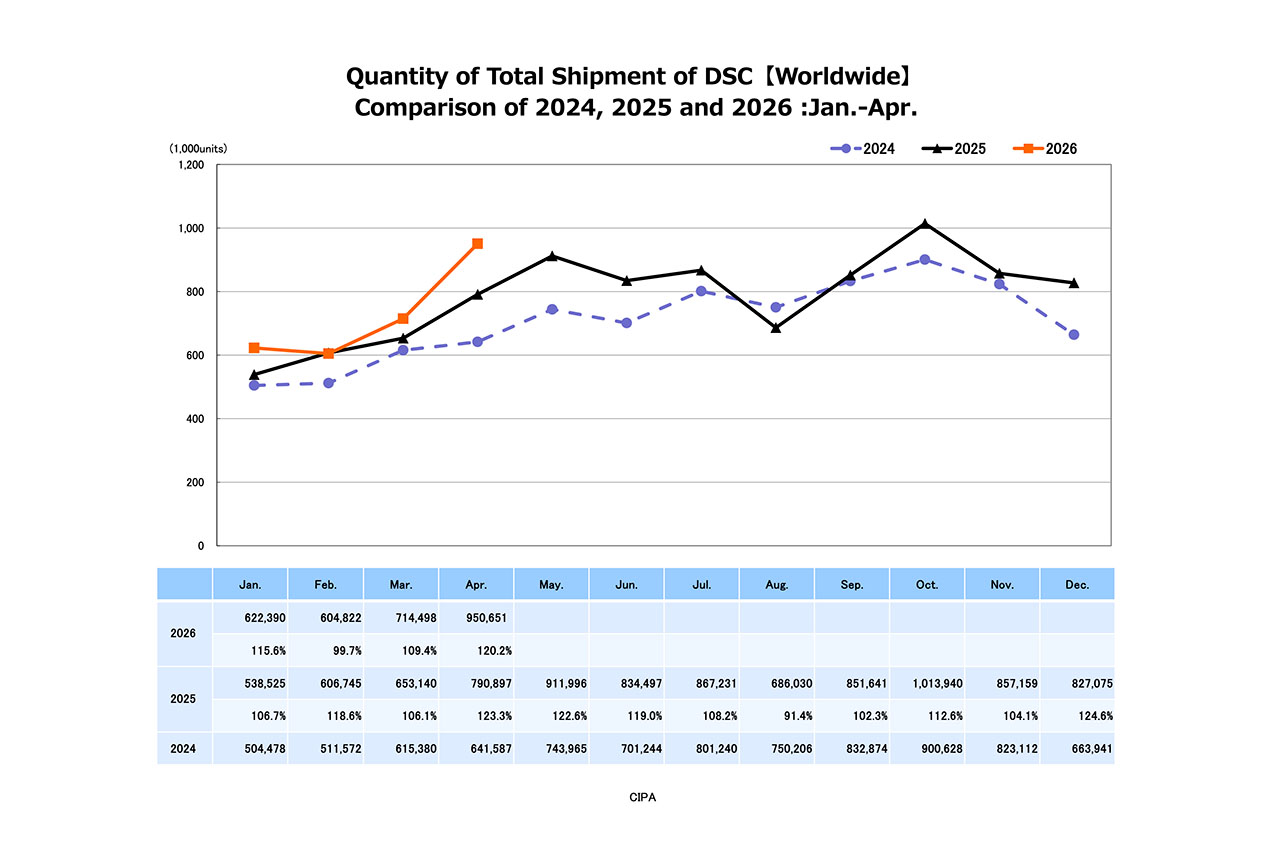
CIPA April 2026: Compact Cameras Surge 30%, Mirrorless Steady, DSLR Fading Fast
The camera industry is growing again. That is the headline from CIPA’s April 2026 data, and for an industry that spent the better part of a decade in decline, it is worth pausing to appreciate. But the growth is not evenly distributed. Some segments are booming. Others are barely holding on. And one is quietly disappearing.
Here is the full picture, straight from the numbers published by the Camera and Imaging Products Association of Japan.
The data at a glance
CIPA’s April 2026 report covers production and shipment data for digital cameras and interchangeable lenses. Here is the big picture first.
| Metric | April 2026 | vs March 2026 | vs April 2025 | Jan-Apr 2026 | vs Jan-Apr 2025 |
|---|---|---|---|---|---|
| Total Production | 804,495 | +4.8% | +8.3% | 2,839,089 | +13.9% |
| Global Shipments | 950,651 | +33.1% | +20.2% | 2,892,361 | +11.7% |
| Global Shipment Value | ¥99.5 billion | +64.2% | - | - | - |
The shipment value spike in April is primarily driven by the monthly production surge and a favorable product mix weighted toward higher-value mirrorless bodies and lenses. Note that CIPA added one new member company to its survey starting January 2026, and year-over-year comparisons already reflect that change.
Now, the category-level view. All percentage changes below are year-to-date versus the same period in 2025.
| Category | Change (YTD vs 2025) |
|---|---|
| DSLR Cameras | Units -31%, Value -39% |
| Mirrorless Cameras | Units +11%, Value +11% |
| Compact Cameras | Units +30%, Value +26% |
| Lenses (APS-C and smaller) | Units +12%, Value +21% |
| Lenses (Full-frame and larger) | Units flat, Value +3% |
The lens-to-body sales ratio held steady at 1.55, unchanged from a year ago. The industry is on track to ship between 6.27 and 7.4 million interchangeable lens camera bodies in 2026.
Here is how the unit volumes break down by category.
| Category | April Production | April Shipments | April Shipments YoY | YTD Production | YTD Shipments | YTD Unit Change |
|---|---|---|---|---|---|---|
| Built-in Lens | 211,162 | 246,645 | +29.9% | 790,164 | 803,059 | +30% |
| DSLR | 45,401 | 47,955 | - | 160,087 | 164,457 | -31% |
| Mirrorless | 547,932 | 656,051 | +13.4% | 1,888,838 | 1,924,845 | +11% |
Mirrorless is the undisputed engine of the industry, accounting for 68% of all camera production in April and 69% of global shipments. Compact cameras are a solid second at roughly 26% of shipments. DSLRs are under 5% and falling.
Compacts are the story of the year
A 30% increase in compact camera shipments is not a blip. It is a sustained trend that has now been running for over two years. In April alone, manufacturers produced 211,162 compact cameras, bringing the January-to-April total to 790,164 units.
If you have been paying attention to what is happening on social media, this will not surprise you. Film-style digital compacts, screen-free cameras like the Camp Snap, and premium point-and-shoots like the Fujifilm X100 series and Ricoh GR series have all fueled a renaissance that nobody in the boardrooms of Tokyo predicted five years ago. The compact camera was supposed to be dead, killed by the smartphone. Instead, it has been resurrected by a generation of photographers who want a dedicated camera that does not feel like a computer.
For manufacturers, this is both an opportunity and a problem. The opportunity is obvious: demand is real and growing. The problem is that compact cameras carry lower margins than high-end ILCs, and most companies spent the last decade dismantling their compact camera production lines. Scaling back up takes time.
Mirrorless: steady, but showing cracks at the high end
Mirrorless continues to grow at a healthy clip. Production hit 593,333 units in April, up 33.1% compared to April 2025, with the January-to-April total reaching 2,048,925 units. Shipments across all digital cameras reached 950,651 units for the month.
The 11% year-to-date increase in both units and value is solid, but the lens data tells a more nuanced story. Lenses designed for full-frame and larger sensors, the high-margin glass that drives profitability for Canon, Sony, and Nikon, were essentially flat in unit volume and up only 3% in value. Meanwhile, lenses for APS-C and smaller formats grew 12% in units and a striking 21% in value.
What this suggests is that the mirrorless growth is increasingly being driven by the middle and lower end of the market. Enthusiasts are buying APS-C bodies and glass. The flagship full-frame segment, while still enormous in absolute terms, is not expanding at the same pace. For an industry that has spent years pushing photographers toward ever-larger sensors and ever-more-expensive lenses, that is a signal worth paying attention to.
DSLR: the long goodbye accelerates
DSLR shipments fell 31% in units and 39% in value. Only 45,401 DSLR bodies were produced in April, and the January-to-April total sits at 160,087 units. For perspective, that is fewer bodies across four months than Sony alone probably ships in a bad quarter.
There is a small bright spot buried in the data: DSLR performance improved by about 10% compared to the previous month’s figures. But this is a dead cat bounce, not a recovery. Canon and Nikon have effectively stopped developing new DSLR bodies and lenses. Pentax is the only major manufacturer still actively investing in the format, and its market share is a rounding error. The DSLR is not going to zero overnight, but the trend line is unambiguous.
Where the cameras are going
CIPA breaks out shipment data by destination region, and the April numbers reveal a market that is increasingly driven by overseas demand. Japanese domestic shipments totaled just 90,506 units, down 7.1% from March. The remaining 860,145 units, over 90% of the total, went to international markets.
| Destination | April 2026 | vs March 2026 | vs April 2025 | Jan-Apr 2026 |
|---|---|---|---|---|
| China | 254,831 | +86.8% | +6.9% | 606,917 |
| Americas | 226,490 | +4.0% | +44.0% | - |
| Europe | 203,674 | +34.8% | +14.8% | - |
| Asia (excl. Japan, China) | 126,447 | +39.1% | +28.3% | - |
| Other Regions | 48,703 | +132.0% | +53.0% | - |
| Japan (Domestic) | 90,506 | -7.1% | +3.7% | - |
China and the Americas are the two heavyweights, together absorbing more than half of all cameras shipped globally in April. The 44% year-over-year surge in the Americas is particularly striking and likely reflects a combination of pre-tariff inventory stocking, a strengthening US dollar making imports cheaper, and sustained demand for premium mirrorless gear. China’s month-over-month jump of nearly 87% is the largest sequential gain of any region and points to aggressive restocking by Chinese distributors after a slower March.
Asia outside of China and Japan also posted strong double-digit gains both monthly and annually, signaling that Southeast Asian and Indian markets are emerging as meaningful growth engines for the camera industry. Meanwhile, Japan’s modest 3.7% annual increase confirms what the product mix already suggests: the domestic market is mature and stable, but it is not where the growth story is being written.
What this means for the rest of 2026
The camera industry is in better shape than it has been in years, but it looks different than most executives expected. The growth is not coming from the $6,500 flagship bodies and $3,000 zooms that dominated the product roadmaps of the late 2010s. It is coming from compact cameras and affordable mirrorless kits.
That does not mean high-end gear is in trouble. Canon, Sony, and Nikon all posted strong financials in their most recent quarters, and the profit margins on premium glass remain healthy. But the CIPA data confirms something that many photographers have sensed for a while: the market is broadening, not just climbing upward. The camera industry spent a decade chasing pros and high-end enthusiasts. Now the casual shooter is back, and they are buying cameras nobody expected to sell.
The numbers are not everything, but they are honest. And right now, they say the camera industry is alive, growing, and changing in ways that are going to surprise a lot of people who wrote its obituary a decade ago.