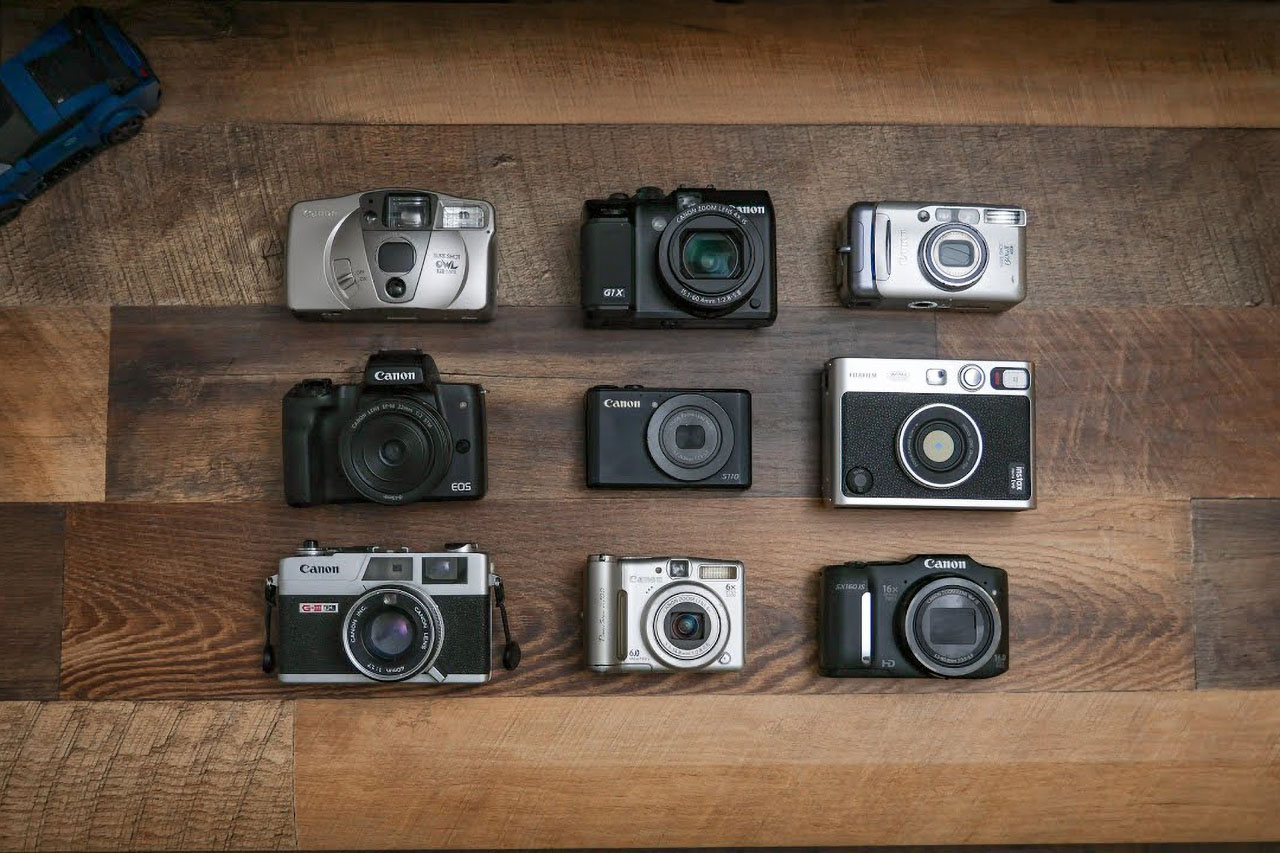
Used CCD Compact Camera Prices Quadruple in Japan as Retro Digital Boom Intensifies
If you still have a clunky 2000s-era digital point-and-shoot buried in a drawer somewhere, now might be the time to dig it out. A new report out of Japan confirms what eBay sellers and vintage gear hunters have suspected for a while: the old CCD compact camera market has gone completely vertical.
Japanese retailer KOMEHYO, one of the country’s largest used-goods chains, says sales volume of “old compact digital cameras” has jumped roughly five times compared to five or six years ago. Prices have followed. The average selling price has climbed to about 3.5 times what it was during the same period. Models that were quietly selling for 5,000 to 10,000 yen back then now routinely move at 20,000 to 40,000 yen. That is a 4x floor, and some outliers push well beyond it.
The report, first published by Pinzuba News and picked up by Digicame-info, comes from on-the-ground reporting at KOMEHYO’s Nagoya flagship store. Yasuhiro Hara, the store’s camera sales floor manager, did not mince words about what is happening.
“Demand for old compact cameras has grown significantly compared to 5 or 6 years ago,” Hara told Pinzuba News. “At our store, sales volume has increased about 5 times, and the average price range has surged to about 3.5 times.”
It is the sensor
The secret is not in the lens design or the body styling, though both play a role. It is in the imaging pipeline. Most compact cameras sold in the 2000s used CCD sensors, a technology that the industry largely abandoned in favor of CMOS by the early 2010s. CMOS won the engineering battle. It draws less power, reads out faster, handles video better, and costs less to manufacture at scale. Today, practically every camera and smartphone you can buy uses CMOS.
But winning on a spec sheet is not the same thing as winning on character.
CCD sensors render color differently. They produce warmer tones, gentler highlight roll-off, and a kind of organic grain structure that reads as “film-like” rather than “noisy.” Modern CMOS sensors are objectively sharper and cleaner. That is precisely what makes them less interesting to a generation of photographers raised on Instagram filters and film simulation presets.
“These provide warmer colors than the CMOS sensors in current cameras and smartphones,” Hara explained, “especially producing a film-like quality in still photos. These old compact cameras have qualities that current cameras don’t have.”
This is not nostalgia talking. It is a genuine aesthetic preference. Low pixel counts, sensor noise, and limited dynamic range become features when the goal is character rather than clinical accuracy. The Japanese term that keeps coming up in coverage of this trend is emo-i: emotionally resonant, imperfect in a way that feels human.
The design nobody is making anymore
Beyond the sensor, there is the hardware itself. Compact cameras from the early 2000s were built during a period of genuine industrial design experimentation. Manufacturers had not yet converged on the black rounded rectangle that defines the category today.
Hara singled out two models from Kyocera’s defunct CONTAX line: the SL300RT, with its rotating lens barrel that lets you angle the lens independently of the body, and the i4R, which requires you to physically pull out the lens panel before shooting. Both pair CCD sensors with Carl Zeiss glass. Both sell the moment they hit the shelf.
“These are individualistic designs you simply cannot find in today’s cameras,” Hara said. The SL300RT and i4R represent something the camera industry stopped making: compact cameras that were genuinely weird and wonderful.
It is not just the halo models, either. Even mundane point-and-shoots from Canon, Nikon, Fujifilm, and Sony’s early digital catalogs are moving. Five or six years ago, Hara noted, a camera that would have been valued at less than 100 yen might now fetch 2,000 yen. That is still not life-changing money, but it is a twenty-fold shift in a category that was considered e-waste not long ago.
The bigger picture
This is not happening in a vacuum. CIPA’s April 2026 data, reported by ShutterCount earlier this week, showed compact camera shipments up 30% year-to-date. That is on top of growth in 2025 and 2024. The compact camera was supposed to be dead, suffocated by the smartphone. Instead, it is the fastest-growing category in digital imaging.
But new production is nowhere near meeting demand. Japan shipped roughly 2.4 million compact cameras in 2025, according to CIPA. That sounds healthy until you remember that the category peaked at 110 million units in 2008. Even after two years of accelerating growth, new compact camera production sits at roughly 2% of its historical peak. The gap between demand and new supply is enormous, and the used market is filling it.
The trend has been building for a while. PhotoRumors flagged it as early as November 2024, when some models had already jumped 20x in a single year. What is new in this latest report is the retailer-level data that quantifies the phenomenon with real sales figures rather than anecdotal listings.
If you are thinking of selling
The Pinzuba News report includes some practical advice for anyone sitting on an old compact camera. Bring the charger and battery. Accessories from 15 to 20 years ago were often proprietary, and replacements are nearly impossible to find today. A camera without its charger may not even be testable, which kills the valuation.
Also worth knowing: cameras this old come with age-related issues. Hara is upfront about it. Components degrade. Screens delaminate. Lens mechanisms get sticky. The market tolerates this to a degree, partly because “imperfection is part of the charm,” but a non-functional camera is still worthless. Power it on before you get your hopes up.
The trend shows no sign of slowing, and with new compact camera production still a rounding error compared to the glory days, used CCD models will likely keep climbing. For photographers who still have a working Digital Elph or Cyber-shot tucked away, the moment has never been better. For everyone else, well, this is what happens when an entire generation decides that “worse” actually looks better.